Thursday, December 1, 2011

Mt. Taranaki and The Forgotten World Highway


We drove about three hours north to Mt. Taranaki wondering if we had made a good choice for our week end excursion. It was rainy and we had been told that the volcanic, snow covered mountain wouldn’t be visible. Upon arriving, it was true that we couldn’t see it, but we drove to the Visitor’s Center anyway and took a short walk to Dawson Falls, very nice even in the drizzle.  Then we headed to the sunnier beach highway and New Plymouth, a nice drive and pleasant town. We saw runners and assumed they were running a very tough and hilly marathon, but later found out it was a 160K run around the mountain and the runners had started the night before. No wonder the runners were looking rough! 


 After seeing a bit of blue sky early Sunday morning and then a glimpse of the peak of Mt. Taranki, we immediately drove to a different park entrance and walked about twenty minutes, oohing and aahing all the way.

This view was a 10!

By the time we were back in the car, the mountain was covered with clouds.


Apparently in the winter skiers must walk the same path that we walked, and then take a gondola across this gorge to the ski hillls! Jim thinks it would be great fun!


The Forgotten World Highway is a 150 km road winding through the picturesque countryside with an almost ghost town, an old coal mining village, good views of the nearby volcanoes when the weather is clear, which it wasn’t, the historic Moki tunnel, and a waterfall. It’s about a three hour drive, but with all the photo ops and hikes it took us eight hours.

Walking through a farmer's field for a waterfall.
Moki Tunnel built in the 1930's

Monday, November 28, 2011

Castlepoint and Napier


A few out of order photos to remind myself of other places we have visited. Castlepoint is one of our favorites spots on the Pacific Coast. It takes longer to get to the Pacific than to the Tasman because of the mountains, but well worth the trip. We climbed around the reef by the lighthouse and then waded in a protected area. A sunny, warm day with cold water. 


The tractor is pulling the fishing  boat out of the water. The boats go into the water with tractors also.


A beautiful spot to wade or swim. And driving on the beach is allowed! I normally wouldn't be in favor of cars on the beach, but it can be a long walk at the end of the day.


Some of the trees are quite large!


Napier, in Hawke's Bay was devasted by an earthquake in 1931 and was rebuilt in the popular art deco style of that time.

Note to myself: We visited Castlepoint the same week end that we saw the Pinnacles and the suspension bridge.  We visited Napier the same week end that we went to Cape Kidnappers.


Tuesday, November 15, 2011

Cape Kidnappers

 
We read about the gannets that nest in Hawke’s Bay at Cape Kidnappers and knew there were a couple of excursions to view the birds. We are not necessarily bird watchers, but it sounded interesting, so after arriving at the departure point at 6:30 on a chilly morning(I was dressed in seven layers (thin, Texas layers), we found seats on a tractor pulled trailer and set off down the beach. Our excellent driver and guide drove along the beach, over rocks, and in the ocean, stopping to show us the debris that came off of the cliffs during a one meter rainfall in April, fault lines from various earthquakes, volcanic ash, seals, and birds.


At the end of our ninety minute ride ending in a lovely beach with great rock formations, we climbed the cliffs and walked through a farmer’s field of cows and sheep to see the incredible Plateau Colony of gannets. The views were pretty spectacular as well! Jim and I could have stayed in this spot all day, but the trip can only be done during low tide, so reluctantly we headed back with the group on the tractor. 

Cape Kidnappers has its name from the time when Captain Cook visited in 1769. The Maori in their canoes went to the ship to trade and somehow ended up taking a Tahitian boy back with them. A few Maori were shot and the boy swam back to the ship. 

By the way, gannets mate for life (20-24 years) and the female and male share in incubation of the egg and chick care after hatching. At fifteen weeks, the chicks fly to Australia and stay for two to three years before returning to live permanently in New Zealand. Only about 25% of the birds survive to return Cape Kidnappers to find their mates. 

On my rating scale, an emphatic 10!


Notice the fault lines
Stunning views at the end of the cape
 

One of three colonies of gannets at Cape Kidnappers

Sunday, November 6, 2011

The Swinging Bridge


One of my recurring nightmares is crawling across a very high catwalk, with nothing to hold onto. So when we came to this swinging bridge high above the river in Waiohine Gorge, I was tempted to head back to the car. We weren’t planning on doing any tramping, so I actually had no need to get to the other side. But reluctantly, I held on tight, didn’t look down, and followed Jim across the bridge. The trip back wasn’t much better, and although I did glance down once, I made no stops for pictures.


My smile is completely fake!
 Jim did stop to take pictures.

The Pinnacles


Knowing the spectacular scenery to come on the South Island, I am trying to be conservative with what I would normally consider at the top of the scale. If I am using a rating scale of 1 to 10 for scenery, then our trip this past week end had a couple of 8’s.


 Our first stop was at the Putangirua Pinnacles where a part of The Lord of the Rings was filmed. We had a steep, scenic, a little scary climb to the lookout to see the pinnacles and after a less than expected scary trip down, we continued on to view the Pinnacles close up. We were glad we were wearing the recommended stout shoes as we walked on ankle turning rocks and jumped across small streams. But, oh, what a reward!


That's me 

It felt like looking up at a castle or a gothic cathedral

Tuesday, November 1, 2011

Mountain Ranges and Kiwi House

 
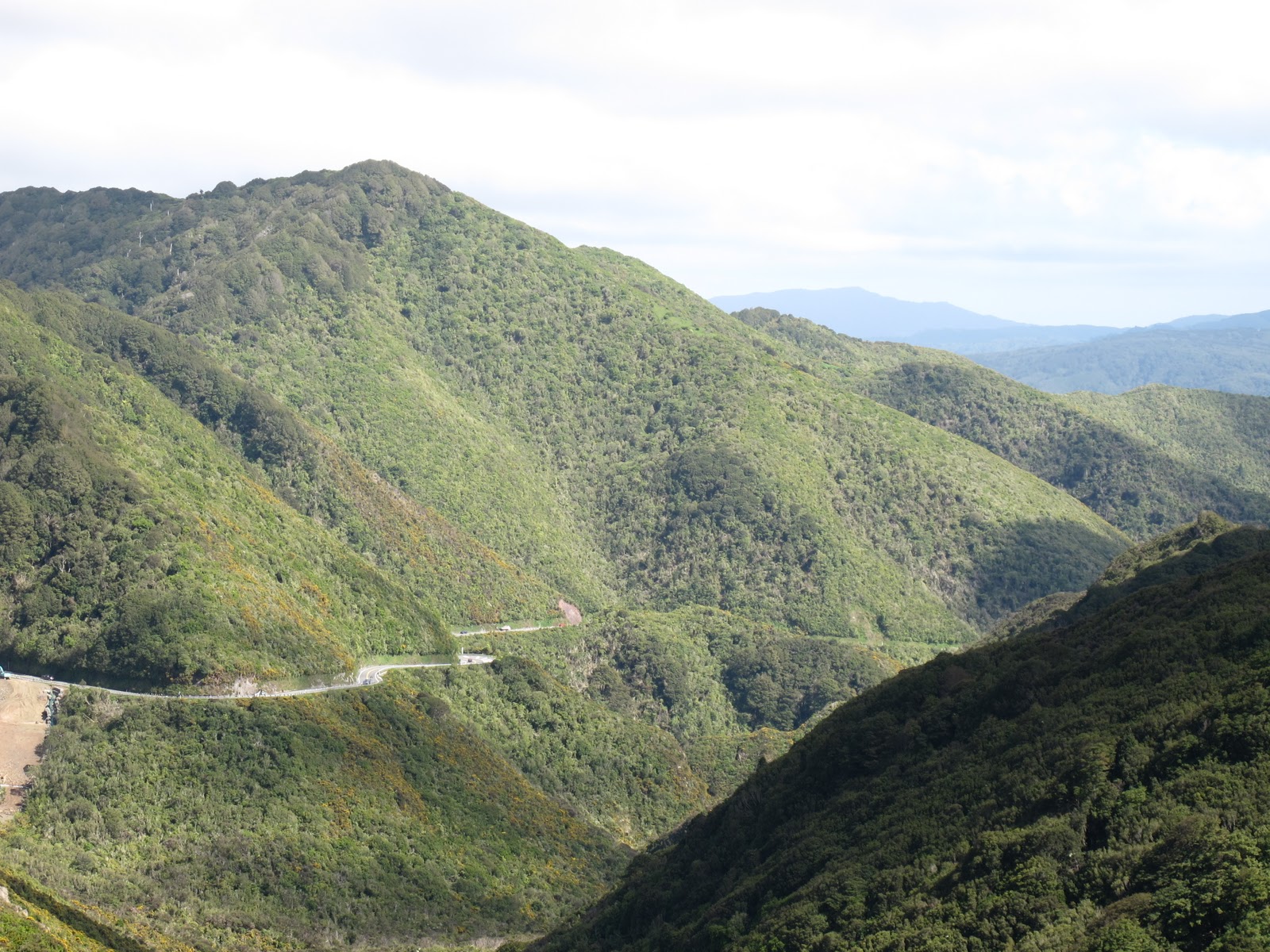
We took the more scenic road home from Wellington, although I think I need to find some type of scenic rating as everything is scenic here. This road wound through the Tararua and Rimauka ranges with the usual breathtaking views and white knuckle driving(or maybe it was just the passenger who had the white knuckles-that would be me). Driving on the other side of the road only added to the excitement of the trip! 


We stopped at Mt. Bruce Pukaha, a wildlife and captive breeding center where many birds are being saved and reintroduced into a safer environment. The kiwi eggs are saved from predators, hatched and fed in the kiwi house, and then returned to the forest. The feeding of the kiwi chick was done with such love, care, and difficulty-kiwi chicks don't want to eat.